
There’s something strange happening in how people find information online. Not strange in a bad way — more like quietly revolutionary, the kind of shift that happens before most people notice it. People are still searching, sure. But increasingly, they’re not getting ten blue links back. They’re getting an answer. One answer. Synthesized, confident, sourced (sometimes), and delivered by an AI that’s decided it knows what you need.
That’s the world brands are operating in now. And if your visibility strategy is still built entirely around ranking in traditional SERPs, you’re optimizing for a version of the internet that’s slowly stepping aside.
This piece is about what it actually takes to show up in AI-generated answers — the real mechanics of it, not the surface-level “write great content” advice that fills most SEO blogs right now.
What AI Search Actually Rewards
Let’s start with the core question: how does an AI model decide who to cite?
The honest answer is that it’s not a single signal. It’s a combination — domain authority, structured data quality, topical depth, how often a brand appears in credible third-party contexts, how clearly their content answers the kinds of questions users ask. Think of it less like an algorithm and more like how a well-read human editor picks sources. They go with what they trust. They go with what’s specific. They go with what they’ve seen consistently.
For brands, this means the work is broader than a keyword strategy. It’s an entity and authority play. And it starts long before you write a single piece of content.
Entity Setup: The Foundation Most Brands Skip
If you want AI systems to cite you, they first need to understand who you are. Not just what your website says — but how your brand is represented across the structured knowledge layer of the web.
This is where entity optimization comes in, and it’s still wildly underused by most brands.
An “entity” in SEO and AI terms is a distinct, identifiable concept — a company, person, place, product — that knowledge systems can reference unambiguously. When Google or an AI model “knows” your brand, it’s because there’s a coherent cluster of structured, consistent information that makes your identity clear.
Practical steps here: make sure your brand has a presence on Wikidata. Ensure your Google Business Profile (if applicable) is complete and consistent. Have a well-structured About page that answers basic factual questions about your organization in plain language. Use Organization schema markup on your site. These aren’t glamorous tasks. But they’re the groundwork that everything else sits on.
Content Architecture for AI Readability
Once your entity foundation is solid, the content layer is where most of the visible work happens.
AI systems — especially the retrieval-augmented generation (RAG) systems that power tools like Perplexity and the AI Overviews in Google — parse content looking for specific, well-structured answers. They don’t just rank pages anymore; they pull passages. Which means the way your content is structured matters as much as what it says.
A few principles that actually move the needle:
Use direct, question-framed headings. If someone might ask “what is AEO?” your page should have a heading that either mirrors that phrasing or answers it directly beneath a clear heading. AI systems retrieve passages, not pages — the cleaner the structure, the easier the extraction.
Define terms explicitly. AI models love clear definitions. If you’re writing about a niche concept, spell it out plainly early in the piece. Don’t assume context.
Keep paragraphs tight and focused. Dense, multi-point paragraphs are harder to extract cleanly. Short, focused paragraphs with clear singular points are much more “AI-retrievable.”
Use lists and tables for comparative or procedural content. These formats translate well into AI answers. They’re clean, structured, and directly usable.
The Role of Topical Authority
Here’s something that gets glossed over in most AEO discussions: topical authority matters enormously. An AI model isn’t just evaluating a single page — it’s implicitly weighing the depth and breadth of your coverage on a subject.
A brand that has twenty substantive, interlinked pieces on a specific topic sends a fundamentally different signal than a brand with one solid page and a handful of surface-level posts. The former looks like an authority. The latter looks like someone who wrote one good thing.
This is why content strategy for AI visibility isn’t just about individual articles — it’s about building a coherent topical ecosystem. Hub pages, supporting cluster content, internal linking that reflects the logical structure of your subject matter. All of it compounds.
Third-Party Signals: The Part You Can’t Fake
This is probably the most underappreciated piece of AEO strategy for visibility in AI search: your own website is only part of the picture.
AI models don’t just read your content. They read the web. And what the web says about you carries enormous weight. Mentions in industry publications. Analyst reports that reference your brand. Journalists quoting your founders or citing your data. Guest posts on authoritative sites. All of these are trust signals that feed into how likely an AI system is to surface your brand when the topic comes up.
This is why the SEO tactic of building a hermetically sealed content silo — great internal content, minimal external presence — doesn’t translate well to AEO. You can have the best-written, most-structured content on the planet, and if the broader web ecosystem doesn’t reflect your authority, you’ll still be undercited.
Building that external footprint takes time. But there are concrete ways to accelerate it: publish original data that others will reference, pursue guest contributions on high-authority publications, get your executives quoted in press coverage, and invest in building the kind of resource pages that journalists and researchers naturally link to.
Schema Markup and Structured Data
Still worth saying plainly, even though it’s not new: schema markup is one of the clearest signals you can give to both traditional search engines and AI indexers.
FAQ schema, How-To schema, Article schema, Organization schema — these help machines understand not just what your content says but what type of content it is and how it’s structured. For AI systems that are trained on or retrieved from the structured web, this metadata is genuinely useful.
Don’t overcomplicate it. Start with the most relevant schema types for your content and implement them cleanly. Test with Google’s Rich Results tester. Then move on.
Measurement: How Do You Know It’s Working?
This is where AEO gets genuinely tricky. Traditional SEO has clean metrics — rankings, impressions, clicks. AEO doesn’t yet have a standard dashboard.
What you can track: how often your brand appears when you manually query relevant topics across major AI tools (ChatGPT, Perplexity, Gemini, Claude). Whether your content is being retrieved in AI Overviews in Google Search Console. Referral traffic from AI-adjacent sources. Brand search volume trends.
It’s messier than keyword rankings. But the brands that start measuring now will have a significant advantage when more standardized AEO analytics tools mature — which they will.
Pulling It Together
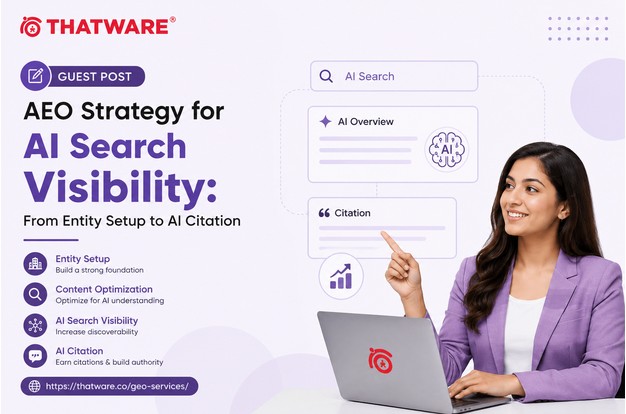
The honest version of AEO services isn’t a magic switch. It’s a coherent, multi-layer strategy that works on entity setup, content architecture, topical depth, and external authority simultaneously.
None of these pieces alone is enough. But together, they build the kind of presence that AI systems consistently reach for when generating answers.
The window to establish that presence — before your competitors do — is still open in most industries. The brands that treat AEO as a serious strategic priority in 2026, not just an add-on to their SEO checklist, will be the ones getting cited two years from now when AI-mediated search is even more dominant than it is today.
That’s not speculation. It’s just where this is going.